
There is a kind of cooking that is barely cooking at all, where the whole of the result rests on the quality of two or three things and the care with which you bring them together. A bread dip of olive oil and balsamic is exactly this. It asks nothing of you but a wide dish and five minutes, and it gives back something that can quietly anchor a table for an afternoon.
Because so little stands between you and the plate, there is nowhere for a poor ingredient to hide. This is a dish to make when you have a good bottle of each to hand, and a loaf worth tearing.
Why the balsamic matters
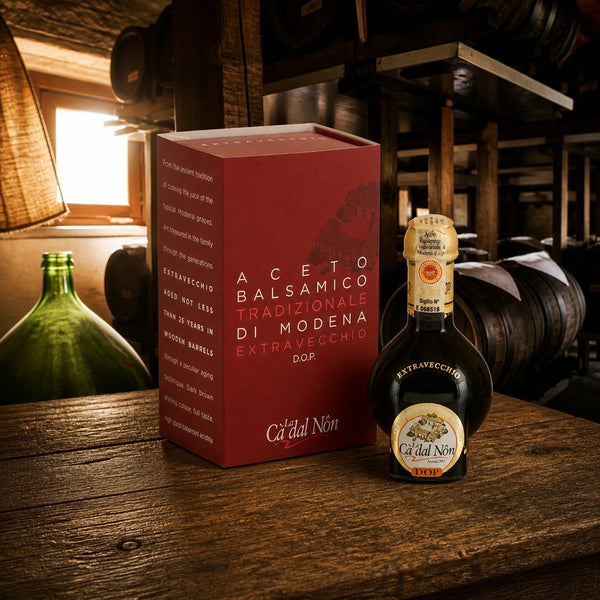
The balsamic is what turns oil and bread into something memorable. La Cà dal Nôn Balsamic Vinegar DOP is aged slowly in a succession of wooden casks, and that patience shows in the glass. It is thick and glossy, dark as treacle, with a sweetness that arrives before the acidity and a depth that a young supermarket vinegar simply cannot reach. A teaspoon or two is all you need. Drizzled through the oil, it sinks and pools beneath, holding its shape rather than dispersing, which is both the visual signature of the dish and the proof of a vinegar that has earned its age.
The olive oil carries everything else. Nikkitas Extra Virgin Olive Oil, single-estate and pressed from a single Greek harvest, brings a green, peppery weight that fills the mouth and gives the balsamic something to rest against. Where the vinegar is sweet and sharp, the oil is grassy and round, with that faint catch at the back of the throat that marks a fresh, properly made oil. Pour it generously. It is the body of the dish, not the background.
Ingredients
- 4 tbsp Nikkitas Extra Virgin Olive Oil, the freshest you have
- 1 to 2 tsp La Cà dal Nôn Balsamic Vinegar DOP, depending on how sweet and sharp you like it
- 1 small clove garlic, finely grated (optional)
- A pinch of dried oregano or a few fresh thyme leaves
- Flaky sea salt and freshly cracked black pepper
- Crusty sourdough or ciabatta, sliced or torn, to serve
A note on substitutions: a good aged balsamic is the one thing not to compromise, since it is doing most of the work. If you have no fresh thyme, dried oregano or a little rosemary will sit just as happily in the oil.
Equipment
- A wide, shallow dish or rimmed plate
- A fine grater or microplane, if using garlic
- A teaspoon for drizzling the balsamic
Method
- Pour the oil. Tip the olive oil into a wide, shallow dish or plate. A broad surface matters here, as it gives the balsamic room to pool and keeps the ratio of oil to bread generous in every dip.
- Season the oil. If you are using garlic, stir it into the oil now along with the herbs and a generous pinch of salt. Letting these sit in the oil for a moment lets their flavour bleed gently into it before the bread arrives.
- Add the balsamic. Drizzle the vinegar in a slow stream through the centre of the oil. Being heavier and denser, a properly aged balsamic will sink and pool beneath the oil rather than mixing in, giving the two-tone look that is the whole pleasure of the dish. Resist the urge to stir.
- Finish and serve. Crack over fresh black pepper and bring it to the table with torn bread alongside. Each piece should catch both the oil and a streak of the balsamic from below as it goes in.
Chef's notes and common mistakes
- Do not whisk the two together. The appeal is in the contrast, the oil pale and green, the balsamic dark beneath. An emulsion turns it muddy and loses the point.
- Use a wide dish, not a small bowl. A narrow bowl makes the oil too deep and the dip clumsy. Shallow and broad is the way.
- Go gently on the balsamic. A good DOP vinegar is intense and a little goes a long way. You can always add another few drops, but you cannot take it back.
- Season the oil, not the bread. Salt and pepper in the oil season every dip evenly, rather than landing all at once on a single slice.
Variations
The dish takes well to small additions, provided they stay quiet. A grating of Parmigiano over the surface gives a savoury edge. A pinch of chilli flakes brings a little heat. For something more aromatic, warm the herbs briefly in the oil first, then let it cool before plating. Leave the garlic out altogether for a cleaner, purer expression of the two heroes.
Make ahead and storage
This is a dish to assemble at the last moment, since the beauty of the two-tone pool fades once it has stood and the layers begin to merge. You can, however, infuse the oil with garlic and herbs an hour or two ahead and leave it covered at room temperature, then add the balsamic only as you bring it to the table. Any leftover oil keeps in a sealed jar in the fridge for a few days, though it is best brought back to room temperature before use.
Serving and pairing
Serve with a properly crusty loaf, a good sourdough or a ciabatta with an open, chewy crumb that drinks up the oil. Tear rather than slice for the best texture. It makes an unhurried start to a meal or a centrepiece for grazing, alongside olives, a wedge of hard cheese and a little cured meat. To drink, a crisp, dry white sits well against the richness of the oil, while a light, bright red picks up the sweetness of the balsamic.