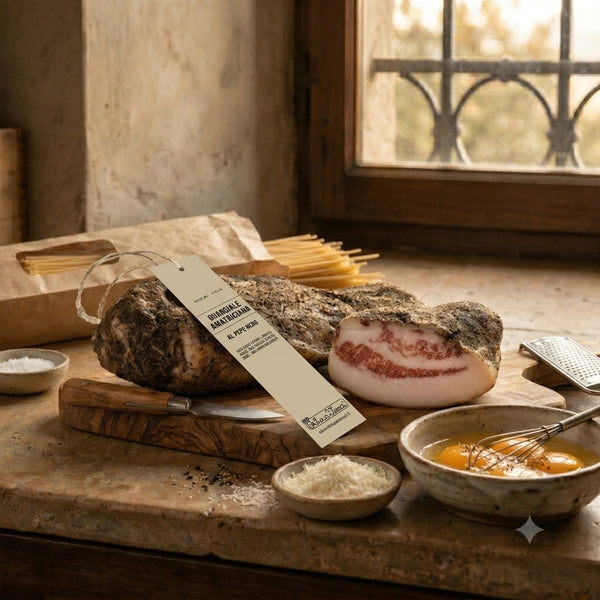

Piselli al guanciale is one of the quiet staples of the Roman table: sweet peas braised gently with onion in rendered guanciale fat, finished with the crisped pork itself. It appears beside roast lamb at Easter, next to abbacchio in trattorie, and on home tables whenever spring peas arrive. Like most Roman cooking it is almost embarrassingly simple, three main ingredients and twenty minutes, and like most Roman cooking it depends entirely on the quality of what goes in.
The dish is a lesson in what guanciale does that no other ingredient can. The peas do not merely sit alongside the pork; they braise in its fat, taking on a sweet-savoury depth that transforms them from a side dish into something people reach for first.
Why the guanciale matters
Rendered slowly, guanciale gives a silky, aromatic fat that coats each pea as it braises, carrying the flavour of the cure into the vegetable itself. The crisp pieces then return at the end for contrast: soft sweet peas, crisp salty pork. Bacon makes this dish smoky and coarse; pancetta makes it flat. The cheek makes it Roman.
Ingredients
- 500g peas, fresh podded in season, or good frozen petits pois the rest of the year
- 120g guanciale, cut into small batons
- 1 small white onion or 2 spring onions, finely sliced
- 100ml light stock or water
- Freshly ground black pepper
- A few leaves of mint or parsley, optional, torn at the end
Equipment
- A wide sauté pan with a lid
- A slotted spoon
Method
- Render the guanciale. Start the batons in a cold pan over medium heat and render slowly until golden and crisp. Lift out and set aside, leaving the fat.
- Soften the onion. Lower the heat, add the onion to the guanciale fat, and cook gently until translucent and sweet, about 5 minutes, without colouring.
- Braise the peas. Add the peas and the stock, season with pepper, cover, and braise gently: 6 to 8 minutes for frozen peas, 10 to 15 for fresh, until tender and glossy.
- Finish. Uncover, let any excess liquid reduce to a glaze, fold the crisp guanciale back through, and finish with the herbs if using. Taste before adding any salt; the guanciale usually brings enough.
Chef's notes and common mistakes
- Do not brown the onion. It should melt into sweetness, not caramelise; colour makes the dish taste heavy.
- Frozen peas are honourable. Romans use them for most of the year. Petits pois, added straight from frozen, keep their sweetness better than tired fresh peas.
- Keep the guanciale crisp. It goes back in at the very end. Simmered in the braise, it turns soft and is wasted.
Variations
Some Roman households add a splash of white wine before the stock; others finish with a little grated Pecorino. Folded through fresh egg tagliatelle with a ladle of pasta water, the same preparation becomes a complete primo. And beside roast lamb, chicken, or a pork chop, it is the classic Roman contorno.
Make ahead and storage
Piselli al guanciale reheats better than most Roman dishes: keep it refrigerated for up to two days and warm it gently with a spoonful of water, adding the reserved guanciale after reheating so it stays crisp. It does not freeze well; the peas turn mealy.
Serving and pairing
Serve warm rather than hot, beside roast meats or as part of a spread of vegetables. With a glass of dry Frascati it also stands alone as a lunch with bread. In spring, with the first fresh peas, it needs nothing else at all.