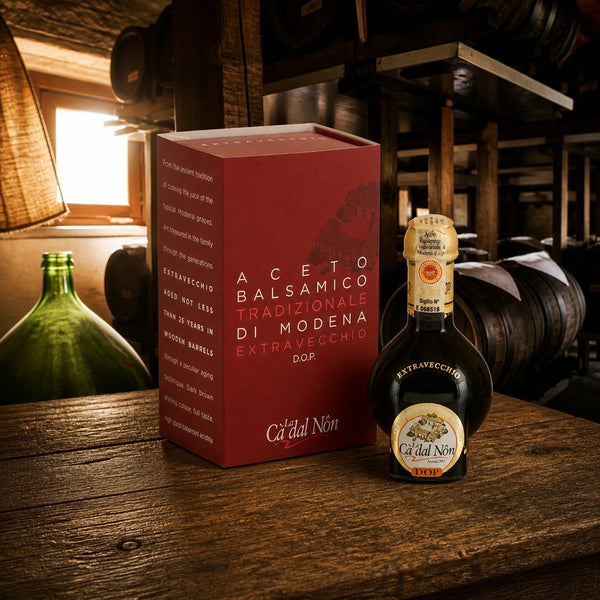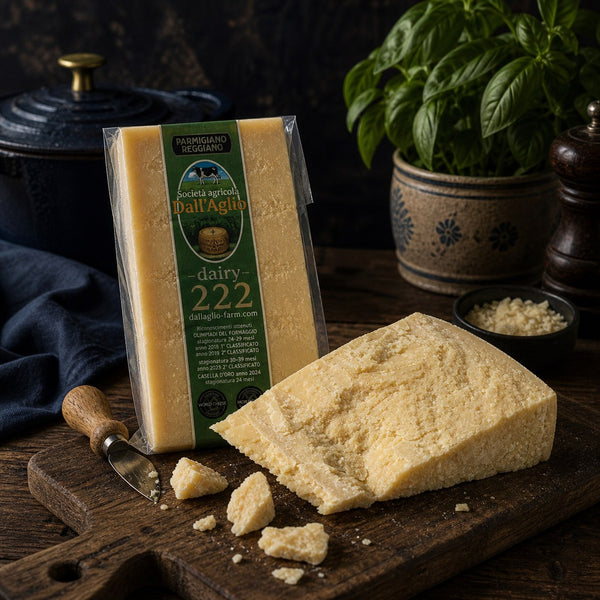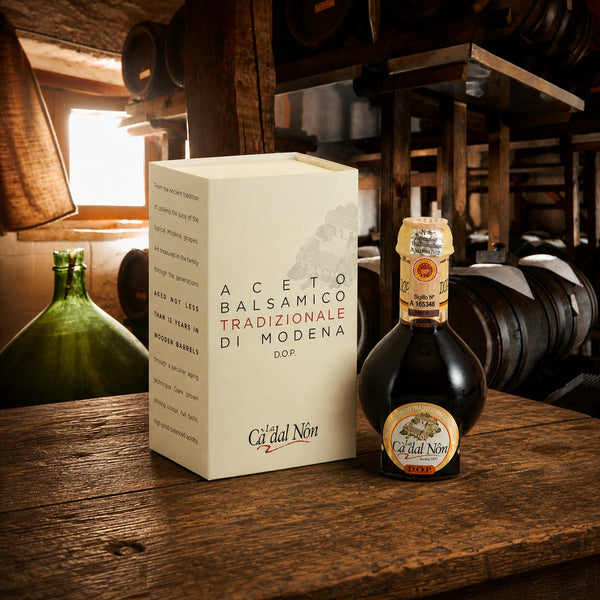

There are pairings, and then there is the marriage of Parmigiano Reggiano and traditional balsamic vinegar, two of the great products of Emilia-Romagna, made within a few miles of each other and destined to be eaten together. In Modena and Reggio Emilia it is not a recipe at all but a reflex: at the end of a meal, someone breaks a wedge of aged Parmigiano into rough shards, sets out a small bottle of the family's aged balsamic, and you help yourself. A drop of dark, sweet vinegar on a salty, crystalline shard of cheese is one of the most complete single mouthfuls in Italian food.
Calling it a recipe almost overstates the effort involved. What it is instead is a lesson in why these two things are worth buying well: put a great Parmigiano next to a great balsamic and the sum is far larger than the two remarkable parts.
Why the balsamic and the Parmigiano matter
This is a dish of two ingredients, so both must be worth eating on their own. A properly aged Parmigiano Reggiano, matured 24 months or more, is dry, deeply savoury and studded with the little crunchy crystals of tyrosine that mark a long affinamento. A traditional aged balsamic is its perfect foil: sweet where the cheese is salty, syrupy where it is dry, fruity where it is nutty. The contrast is the entire point, which is why a young rubbery Parmigiano or a thin sharp balsamic will not do. Buy both as well as you can and the pairing looks after itself.
Ingredients
- A wedge of Parmigiano Reggiano, aged 24 months or more, about 200g
- Traditional aged balsamic vinegar, ideally extra-aged
Equipment
- A short, stubby Parmesan knife, or any sturdy blade
- A serving board
Method
- Break, do not slice, the cheese. Push the point of a stubby knife into the wedge and lever off irregular, craggy shards. The rough broken surfaces hold the balsamic and give the right shattering texture; neat even slices lose both.
- Arrange. Pile the shards loosely on a board and bring to room temperature if the cheese has been chilled, which lets its aroma open up.
- Finish with balsamic. Just before serving, drip a little aged balsamic over the shards, or set the bottle alongside and let people add their own drops. A single drop per piece is plenty.
Chef's notes and common mistakes
- Shards, not slices. The broken texture is not for show. It is what catches the balsamic and gives the cheese its characteristic crumble.
- Room temperature. Cold Parmigiano is mute. Take it out of the fridge half an hour before serving to wake up its flavour.
- Restraint with the bottle. A traditional balsamic is concentrated and expensive for good reason. Drops, not drizzles.
- Do not add oil, salt or anything else. Two ingredients is the recipe. Anything more is a different dish.
Variations
The pairing is the base of an easy, generous aperitivo. Add a bowl of walnuts, a few fresh or dried figs, some good bread or a handful of grapes, and pour a glass of Lambrusco. Fresh pear alongside the cheese, with the balsamic over both, is a classic autumn plate. For a warm version, drape the shards over a rocket salad and finish with the balsamic and a little olive oil, though at that point you have wandered from the pure pairing into a proper starter.
Make ahead and storage
There is nothing to make ahead, which is part of the appeal. Keep the Parmigiano wrapped in the fridge and break off shards as you need them; a well-aged piece keeps for weeks. Add the balsamic only at the moment of serving, so its aroma is at its liveliest and the cheese stays dry and crumbly rather than soaking.
Serving and pairing
Serve at the start of a meal as an aperitivo, or at the end in the Italian way, in place of a sweet dessert. Sparkling Lambrusco is the regional wine and its acidity is perfect against the rich cheese; a glass of Prosecco or a nutty aged white does the same job. This is also the simplest possible way to make a good bottle of balsamic and a fine wedge of Parmigiano the centre of attention, which is exactly what both deserve.