

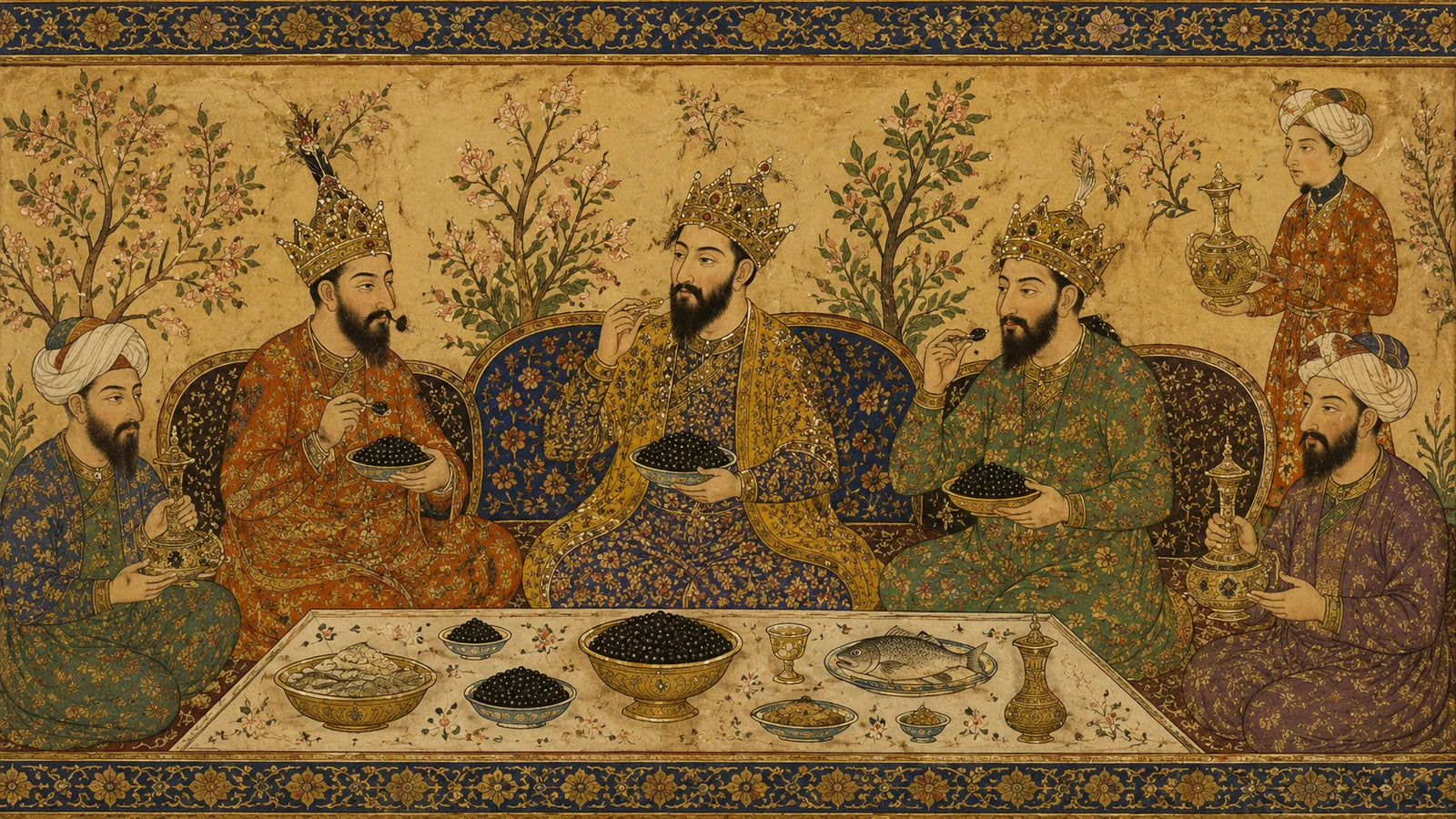
Few foods carry as much history in a single tin as caviar. Salt-cured sturgeon roe has been treasured for thousands of years, passing through the courts of ancient Persia, the palaces of Russian tsars, and the finest restaurants in the world before arriving at our tables today. Here is the story of how it got there.
5 Key Moments That Shaped Caviar's History
Ancient Persia (c. 400 BC). The story begins along the shores of the Caspian Sea. Ancient Persians are believed to have been among the first to harvest and eat sturgeon roe, valuing it not just for flavour but for its perceived ability to restore energy and vitality. The word 'caviar' originates from the old Persian 'khavjar', meaning 'bearing eggs'.
Medieval Russia and Byzantium. By the Middle Ages, caviar had become a staple food for Russian Orthodox monks and fishermen who netted sturgeon from the Volga and Don rivers in enormous quantities. The tsar eventually claimed ownership of all sturgeon in Russian waters, transforming a common food into a symbol of imperial power.
Europe (16-18th centuries). Russian tsars gifted caviar to European royalty, embedding it firmly in the language of luxury. By the 18th century, Beluga caviar was considered among the most prestigious gifts one sovereign could offer another - more prized than gold in some circles.
The American Boom (19th century). Extraordinarily, the United States was once the world's leading caviar producer. Atlantic sturgeon were so abundant in rivers such as the Delaware and Hudson that caviar was served free in American saloon bars to induce patrons' thirst, but overfishing collapsed the stocks within decades.
The Conservation Era (1998-present). Decades of overfishing and habitat destruction drove sturgeon species to the brink of extinction. In 1998, CITES (the Convention on International Trade in Endangered Species) placed all sturgeon under international trade controls. Wild caviar exports from the Caspian were banned, and since 2008, virtually all caviar on the market has come from farmed sturgeon.
The caviar available today is, in many respects, better than anything that came before. Modern aquaculture has refined the entire process - from the water quality to the precise moment of harvest - producing roe of exceptional quality.
At Fine Source, we offer fully certified, sustainably sourced caviar, shaped by history, which we hope you will enjoy fully.
