

Since 2008, virtually all caviar on the market has come from farmed sturgeon. Wild harvesting is largely a thing of the past, meaning that the quality of caviar today depends almost entirely on the skill and patience of the producer. Here is exactly what that process involves.
The Full Journey: Sturgeon to Tin
The Sturgeon Lifecycle. Sturgeon are among the oldest fish species on earth and among the slowest to mature. Depending on the species, a female sturgeon takes from 5 to 25 years to produce roe. Siberian sturgeon are ready in as little as 5-7 years and Beluga can take 20 years or more. That maturation time is one of the primary reasons for caviar's high prices.
Farming Conditions. Reputable farms control every variable - water temperature, flow rate, oxygen levels, and feed. The quality of the water directly affects the flavour of the roe. Many of the world's best producers use spring water or filtered river water, and some farms are located in places where the natural conditions are close to the sturgeon's original habitats.
Monitoring Roe Development. Producers use ultrasound technology to monitor the development of the roe inside the female fish. Harvesting too early produces an underdeveloped flavour, and if too late, the pearls begin to deteriorate, so getting it right is a matter of expertise.
Harvesting. There are two methods. The traditional approach and a more modern, 'no-kill', method in which the roe is gently massaged from the fish without killing it, allowing the sturgeon to produce roe again.
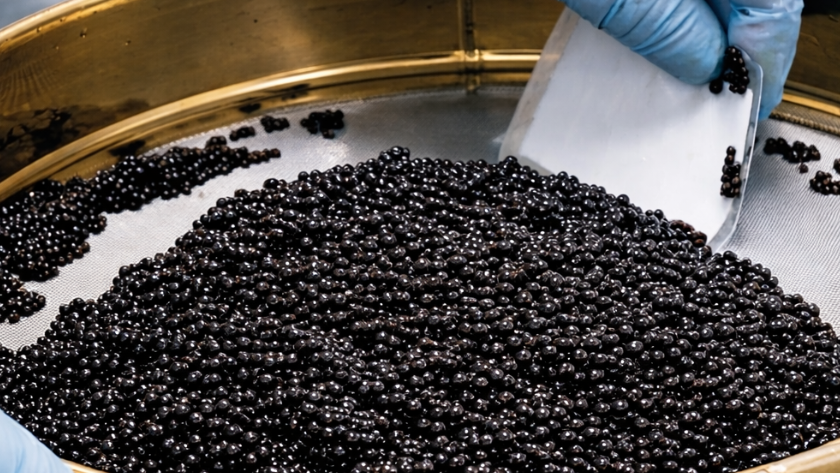
Roe Extraction and Cleaning. Once harvested, the roe is passed through a fine sieve to separate the eggs from the membrane, and the pearls are then rinsed carefully in cold water. Speed and temperature control at this stage are critical as the eggs are highly perishable from the moment they leave the fish.
Salting. The cleaned roe is salted - a process known as malossol, meaning 'little salt' in Russian. The best caviar uses only 3-5% salt by weight. The salt draws out moisture, firms the membrane slightly, and acts as a natural preservative, while preserving rather than masking the flavour.
Maturation. After salting, the caviar is left to rest. This brief maturation period of a few weeks allows the flavour to develop and the salt to integrate evenly. Some producers extend this period, producing caviar with greater depth and complexity, comparable to the difference between a young and an aged cheese.
Packaging. The caviar is packed into tins. Air is minimised inside the tin to slow oxidation. Tins are sealed, labelled with species, origin, and harvest date, and transferred immediately to cold storage.
Quality Control. Reputable producers carry CITES certification - the international documentation that confirms the caviar has been legally farmed and processed. Without it, provenance cannot be verified. At Fine Source, every tin we stock carries full certification, tracing the caviar from farm to your table.
